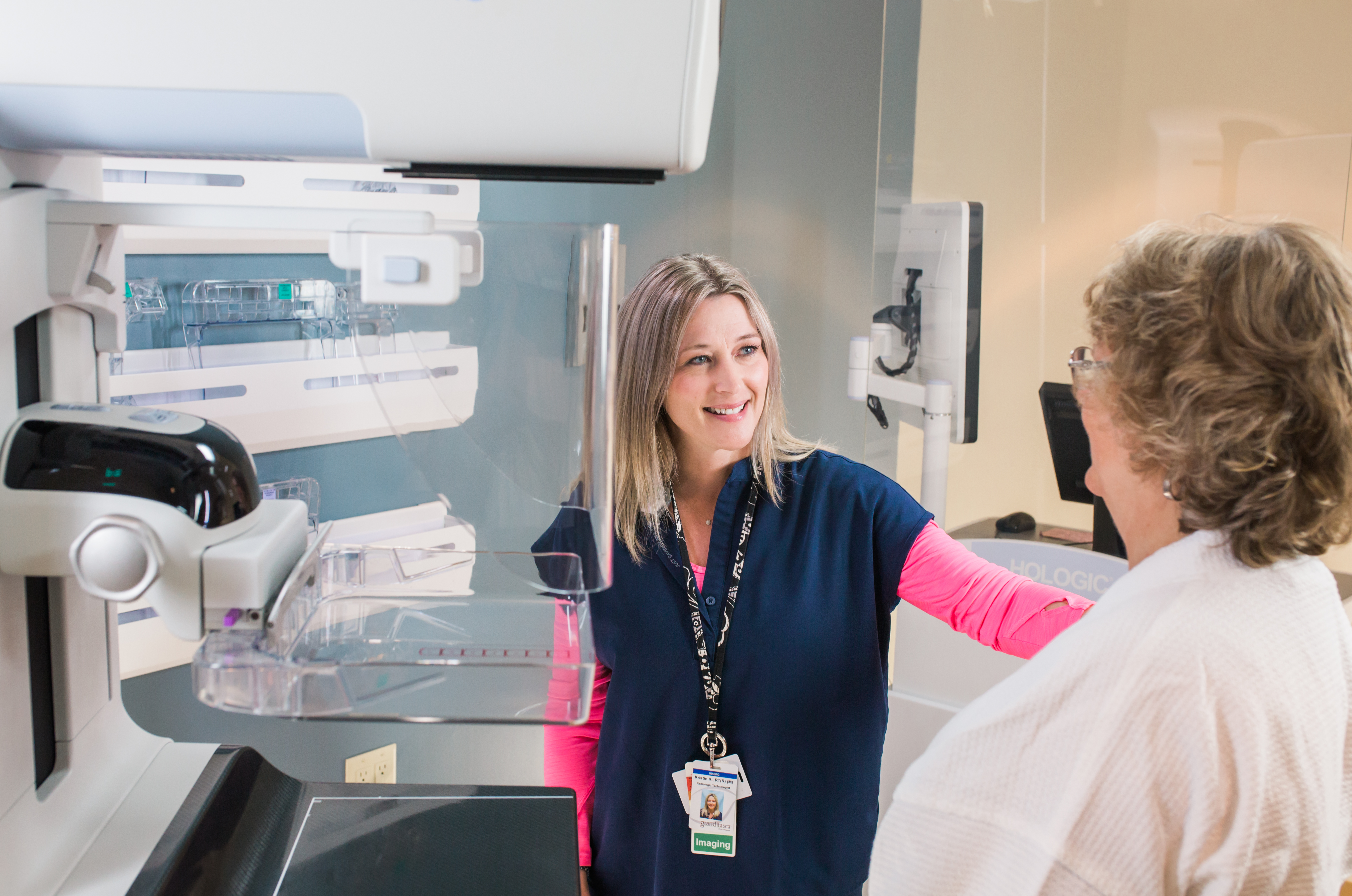
Breast Care
Mammography
Frequently Asked Questions
- Screening mammogram: An X-ray of the breast used to look for breast disease in women who do not have any symptoms of breast problems. The breast is pressed between two plates to flatten and spread the tissue. An X-ray is taken of the breast from different angles. A radiologist views and interprets the result. Screening mammograms are suitable if you have no breast health symptoms. They generally take 10-15 minutes to perform and most women do not experience more than minor discomfort.
- Diagnostic mammogram: A diagnostic mammogram is used when a patient has breast problems or receives abnormal results from a screening mammogram. Additional X-ray images are taken and enlarged to make evaluation and detection easier. Diagnostic images are interpreted immediately and often you receive your results almost immediately after the mammogram. If a diagnostic mammogram does show an area that needs additional evaluation, your provider may recommend you undergo additional breast imaging (ultrasound) or have a breast biopsy. If a biopsy is recommended, it does not mean you have cancer. The majority of biopsies—nearly 80%—are found to be non-cancerous (benign). In many cases, a diagnostic mammogram will show that an abnormal-looking area is not cancer. In those cases, the provider may recommend you return at a later date for a follow-up mammogram.
Three-dimensional (3D) mammograms are available at Grand Itasca. Benefits of 3D mammograms include:
-
Improved rate of cancer detection
-
Decreases “false-positive” results that can result in additional testing, including more invasive testing procedures, such as biopsy or surgery
-
Can provide clearer images of the breast if you have dense breast tissue
-
3D mammography is an optional exam that anyone can have with a 2D mammogram; 2D mammograms remain an effective screening test for all women
-
On the day of your exam, don't wear deodorant or antiperspirant. Some of these contain substances that can show up on the X-ray as white spots. If you're not returning home after your exam, you may want to bring along your deodorant or antiperspirant to put on after the exam.
-
You may find it easier to wear a skirt or pants, rather than a dress, so that you'll only need to remove your top and bra for the mammogram.
-
If you are still menstruating, try to avoid the week just before your period. Schedule your mammogram when your breasts are not tender or swollen to help reduce discomfort.
-
Always describe any breast symptoms or problems to the breast technologist doing your mammogram. Also, describe any related medical history such as surgeries, hormone use, and any breast cancer that you or a family member has had.
-
Before having any type of imaging test, tell your breast imaging technologist if you are breast-feeding or if you think you might be pregnant.
Breast Cancer
We understand that no two people—and no two cancers—are alike, so we work with you to develop a personalized treatment plan that meets both your medical and your personal needs.
Cancer isn't just a medical condition. It's also a life-changing journey for many. From the moment of diagnosis, we are with you to offer expert medical care, understanding and support.
Why choose Grand Itasca for your Breast Cancer Care?
Nurse Navigators
Our breast care nurse navigators have specialized training in patient/family education, to help patients receiving breast services coordinate a path through treatment.
Cancer Care Support Groups
Educational programs and support groups bring patients and loved ones together in a supportive environment. For more information about current Cancer Support Group offerings, please call 218-999-1921.
Learn more about Cancer Care at Grand Itasca.
Conditions we treat
- Breast cancer
- Breast pain
- Cysts
- High Risk Evaluation and Management of Hereditary Breast Cancer
- Lumps
- Macromastia
- Mastitis
- Nipple discharge

Find a Provider
Our team of trusted providers can offer expert care for your breast health or breast surgery needs.
View Our Providers